 Lucas de Almeida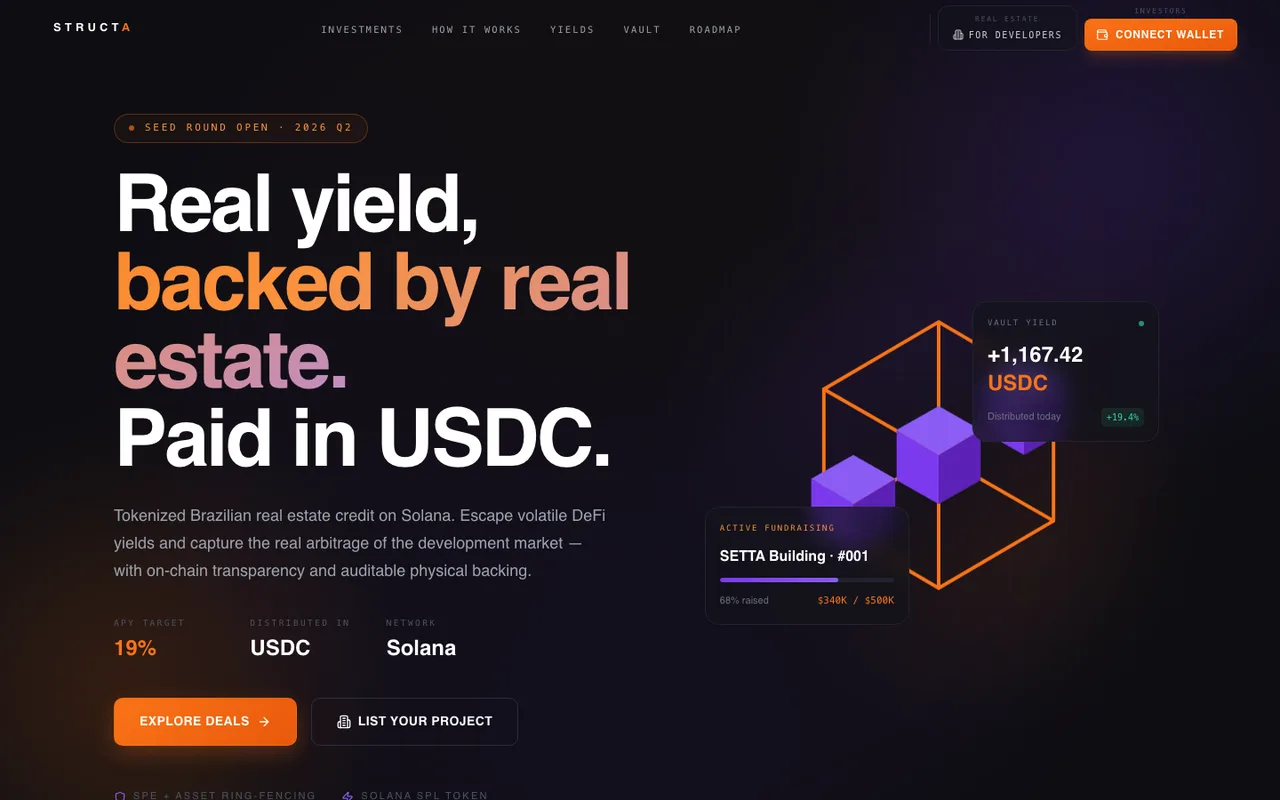
The problem
A mid-sized Brazilian builder funds a development in one of two ways: a line from Caixa Econômica Federal (cheap, slow, heavy on collateral), or private investors buying claims on a specific project (fast, expensive, and run on spreadsheets). I ran the second path for six years. Knowing who owns which claim, paying each holder as units sell, and unwinding everything when a project is cancelled was a full-time job.
Structa moves that accounting on-chain. Each development raises USDC against a fixed number of cotas, distributes yield pro-rata as units sell, and can refund principal if the project stops.
My part
Co-founder, responsible for the product and the protocol design: the cota model, the three-vault split, the yield accumulator and the refund path. Engineering of the program, backend and frontend was led by my co-founder, Eduardo Manczenko.
How it works
One Anchor program serves every development. A project is a set of PDAs derived from a 32-byte seed, so a new development costs account rent, not a new deploy.
admin ── initialize_project ─► ProjectState  PDA["project", seed]
                               ├─ cota mint     (authority: project PDA)
                               ├─ vault_principal (USDC)
                               ├─ vault_yield     (USDC)
                               └─ vault_burn      (USDC)

investor ── buy_cotas ──► USDC → vault_principal, cotas minted to a frozen ATA
admin ──── distribute_yield ──► cumulative_yield_per_token += amount · 1e12 / supply
investor ── claim_yield ──► (cumulative − snapshot) · balance / 1e12
admin ──── unlock_burn ──► remaining principal → vault_burn
investor ── burn_cotas ──► burn, refund at the original price
Design decisions
- Yield is O(1).
distribute_yieldbumps a scaled accumulator; holders claim the delta against their own snapshot. No loops over holders, so it works for any number of them. - Cotas can't move. The program freezes every cota account right after minting and only
thaws inside its own burn path. Yield is keyed to
HolderState, so a plain SPL transfer would otherwise split ownership from payouts. - No retroactive yield. A new holder's snapshot starts at the current accumulator, and every buy or burn settles pending yield before the balance changes.
- One vault per purpose. Principal, yield and refunds never share a token account.
- Distributions must be funded.
distribute_yieldrequires the yield vault to hold everything already promised plus the new amount.
let outstanding = project
    .total_yield_distributed
    .checked_sub(project.total_yield_claimed)
    .ok_or(StructaError::MathOverflow)?;
let needed = outstanding.checked_add(amount).ok_or(StructaError::MathOverflow)?;
require!(ctx.accounts.vault_yield.amount >= needed, StructaError::InsufficientYieldVault);
What could go wrong
| Vector | Status |
|---|---|
| Unauthorised admin calls | Mitigated: every admin context checks has_one = authority and seeded PDAs |
| Vault or mint substitution | Mitigated: vaults pinned with address = project.vault_* |
| Arithmetic overflow | Mitigated: checked_* throughout, u128 intermediates, supply capped at 1e10 |
| Buying just before a distribution to capture it | Mitigated: snapshot on entry, settle before every balance change |
| Secondary transfers breaking yield accounting | Mitigated: cota accounts frozen by the program |
| Rounding | Accumulator truncates; dust stays in the yield vault, which favours solvency |
| Single-key authority (High) | Open. withdraw_principal can send the whole principal vault to any USDC account at any time. Fix: transfer_authority to a Squads multisig with a timelock, and milestone-gated withdrawals |
| Refund shortfall (Medium) | Open. After a partial withdrawal, burn_cotas refunds at the original price first come, first served. Fix: refund pro-rata to the burn-vault balance at unlock time |
| One-step authority transfer | Open. A wrong key in transfer_authority locks admin out. Fix: propose and accept in two steps |
| Legal wrapper | Off-chain by design: issuer KYC, the cota's legal form, and reconciliation with the property registry |
Where it stands
A hackathon prototype. The program is on Solana devnet and the investor flow works end to end in the demo, against test USDC. It isn't an operating product.